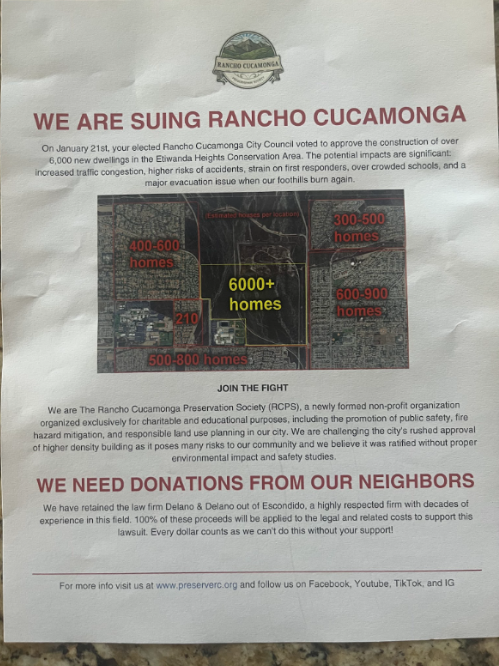
Imagine driving up the hills of Rancho Cucamonga and seeing new houses, shops, and open spaces instead of empty land. That’s the goal of the Etiwanda Heights Neighborhood and Conservation Plan (EHNCP). After years of planning, the project is moving toward its final decisions in 2025 and 2026.
The effort started in October 2017 as the North Eastern Sphere Annexation Project. The city wanted to add more than 4,000 acres of land to Rancho Cucamonga. By 2019, it became the EHNCP. In November 2020, the Local Agency Formation Commission (LAFCO) approved annexing about 800 acres for homes and more than 3,000 acres for conservation, including hiking trails and wildlife protection.
Al Boling, a City Planning Commissioner, explained that a detailed specific plan was needed to decide what kinds of buildings could go on the land. “Once the plan was reviewed by LAFCO, annexation took place,” he said.
The plan divides the area into two main parts. “There’s a conservation area, which will be maintained in perpetuity as a virtually undeveloped area,” Boling said. “That way it provides, maintains, and sustains a natural habitat.”
The project faced delays of four to five years because state laws and city rules kept changing. Officials needed extra time to make sure everything followed the new requirements.
Some residents have concerns. Community member Don Horictich said, “They keep changing the general plan. That’s one of the comments I made. They need to stop changing the general plan to accommodate the developers.”
In late 2025, the city proposed updates to the plan to match newer state housing laws and the city’s 2021 General Plan. Recent meetings discussed allowing more housing types, including duplexes and quadruplexes (small multi-unit homes), alongside single-family houses. This has sparked debate, with some residents worried about density and traffic.
Planning Commissioner Bryan Dopp noted the long-standing need for more homes. “When we were talking about that plan years ago, even then we were talking about the need for housing in the city,” he said. “There was an acute shortage of units.”
Many Planning Commissioners are also local residents. “We live here; we have a vested interest in doing what’s best for the community,” Boling said. “However, sometimes we are restricted as to what we can ask or force developers to do based upon state laws.”
The updated plan and related housing proposals now head to the City Planning Commission and possibly the City Council for final approval. Residents can follow updates through the Day Creek Howl, the City of Rancho Cucamonga’s Planning Department website, or city meetings.
This balance of new homes and protected nature could shape the hills of Rancho Cucamonga for years to come.