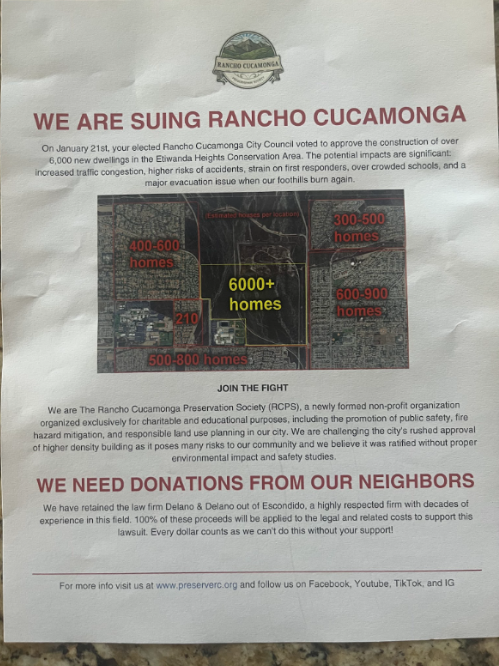
After months of debate and strong community opposition, the Rancho Cucamonga City Council voted last Wednesday to approve the amended Etiwanda Heights Neighborhood and Conservation Plan (EHNCP). The approval came during a packed public hearing where residents voiced ongoing worries about housing density, traffic, and wildfire safety.
The council made several adjustments to address some of the protests. These changes include requiring better ongoing communication between developers and the public, allowing a variety of housing designs, reducing overall housing numbers and density where possible, and limiting buildable areas by excluding spots with power lines, underground utilities, or steep slopes. Ideas like strict deadlines for construction were discussed but not adopted, as officials noted they could rush the process.
Mayor Dennis Michael described the project as one of the most challenging in his 22 years of service. “This is probably one of the most frustrating projects that I’ve ever dealt with in 22 years because of what the state of California has done to try to minimize our ability to manage local control,” he said.
During the meeting, city attorneys explained that California state laws prevent the council from fully blocking housing projects without facing legal issues. As a result, the council focused on modifications to better reflect community requests while complying with state requirements.
Residents at the hearing showed their support for speakers opposing the changes by quietly holding up signs on phones and papers that read “I AGREE.” This silent protest highlighted the intensity of local opposition.
Fire remains a major, and growing, concern for many residents, especially given the powerful Santa Ana winds that frequently sweep through the area. Anyone growing up in Rancho Cucamonga or its surrounding cities know that this force of nature can be calendared every year from late fall to early spring.
Vince D., drawing from his decades of firsthand experience battling wildfires in the region, spoke against the city’s proposals. ”No one but God can stop the winds. I’m a 26-year firefighter, and I’m very concerned about this development. The tiles shake, your windows blow in. Your fireproof fence is not going to stop an ember. It’s 60 miles an hour. New homes are going to replace the brush, but they’re not going to replace the wind or the fire coming off those foothills. I lived through the Grand Prix fire. So all the residents have very valid points, and I will pray that you vote against this amendment. Please for the people,” he said.
Matthew F., a Previti group developer who was present, reassured the room that designs would help maintain steady traffic flow and lower fire risks through features like reduced vegetation fuel and safety standards. He also consoled the room that the prices for smaller homes would start at around $700,000. “The development is going to get rid of a lot of vegetation and the new firebreaks, the hardening standards, none of these homes will have anything flammable within five feet of the home. Even the fences will have to be non flammable material. We believe we will create a significant fire break,” he said.
Still, many residents seemed concerned about the future.
Chris Little, a resident who has spoken at prior meetings, shared his skepticism about emergency plans. “I was told by a council member not to worry about fire evacuations because the city has a system that’ll turn all the lights green to get people out of the foothills. That’s called traffic flushing. It works well on paper, but in reality, when everyone is rushing south, while first responders cut in from the east and the west, the flow stops. It backs up traffic into the foothills. Kind of like what happened in the Palisades. Please deny,” he said.
Christy De Caesar, who has lived in Rancho Cucamonga since 1991, pulled from her personal experience. “I was there during the 2003 fire, and I know how it feels to get out when the fire roars down the mountain. I know how it feels to have only one major road to get out of hundreds of homes, and this was even before the areas grew. Our houses didn’t burn, but it didn’t mean we didn’t want to evacuate. Picture the overcrowded streets and panic that will ensue during a fire, people trying to get out while others are trying to get in to save what they can. Just because the home is fire resistant doesn’t mean people won’t run. Smoke kills, too. Remember, you are our city council, not the developers,” she said.
The approved plan now allows for a mix of single-family homes and some higher-density options, called duplexes and quadruplexes, in the developable part of the area. Much of the land remains dedicated to conservation, trails and open space.
This decision marks the end of a long process that began years ago with annexation and the original 2019 plan. While the council aimed to balance state housing needs with local ideas, some residents continue to worry about its impact on our city.
For more details on the approved plan, visit the City of Rancho Cucamonga Planning Department website at cityofrc.us/etiwandaheights or check the Howl for updates.