
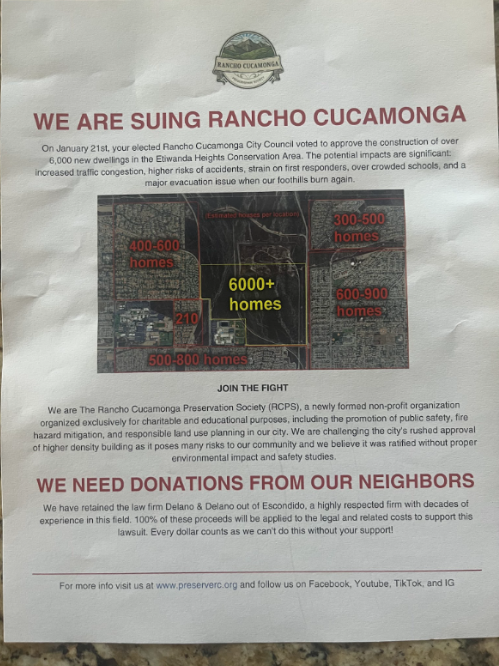
When Rancho Cucamonga resident Chris Little noticed a public notice sign tied to the Etiwanda Heights development proposal, he began researching the project more closely. What started as curiosity soon turned into activism. After attending city meetings and reviewing development plans, Little became one of several residents speaking out against the recently approved Etiwanda Heights and Neighborhood Conservation Plan (EHNCP). Now, opposition to the project has escalated into a lawsuit and a community fundraising campaign aimed at challenging the city’s decision in court.
Many residents argue that the final version of the proposal no longer reflects what community members were originally led to expect. While city officials have said the plan addresses future housing demands and state housing requirements, critics remain concerned about the project’s scale and its potential impact on traffic, infrastructure, emergency evacuation routes, and the environment.
Early proposals for the Etiwanda Heights development in 2019 included approximately 2,700 to 3,000 single-family homes. More recent versions expanded the number of housing units and introduced the possibility of higher-density developments, including duplexes and quadplexes. The project would extend development into Rancho Cucamonga’s northern foothill area, land many residents view as one of the city’s last major stretches of open space.
Little said his involvement began after realizing the proposal had grown beyond what many residents previously discussed.
“I saw a public notice sign and started wondering what it was about,” Little said. “When I looked into it, I realized it was for an expansion of the plan that had already been discussed. Another resident and I decided we needed to let people know.”
In response, Little and other residents created a Facebook group to spread information about the project and encourage community involvement. They also began regularly attending city council meetings to voice their concerns.
“We got to speak for three minutes, and they listened,” Little said. “But they didn’t change their opinion or their plan.”
For many residents opposing the development, frustration stems not only from the council’s approval of the project, but from the belief that public feedback had little influence on the final outcome.
As opposition grew, some residents began discussing legal action. Little recalled one moment during a planning commission meeting that shifted the conversation.
“Someone said, ‘We ought to sue the city,’ and I thought that was a great idea,” he said. “So we decided to move forward with it.”
After consulting with attorneys, the group learned the lawsuit could cost between $50,000 and $100,000. To help cover legal expenses, Little launched a GoFundMe campaign after looking at similar efforts used by other California community organizations involved in development disputes.
“There has been a lot of support,” Little said. “People have responded positively and donated, telling me this is important and to keep going.”
Although critics oppose the current proposal, Little said many residents are not entirely against development itself.
“We’re not against building,” he said. “We just want it done in a way that makes sense, where infrastructure can support it.”
Opponents of the project argue that the surrounding infrastructure is already strained, particularly during periods of heavy traffic or emergency situations.
“It will increase traffic and air pollution,” Little said. “Evacuating could become more difficult if roads are more congested.”
For Little, the debate also reflects a larger concern about whose interests are being prioritized during the decision-making process.
“It feels like they’re representing the desires of the builders,” he said. “They need to pay attention to what the people want.”
Other residents have expressed similar frustrations. One longtime resident, Atana, said the council’s decision felt disconnected from the concerns many community members raised during public meetings.
“It felt like the city council did not really hear or care to understand what residents wanted,” Atana said.
Atana also questioned whether the city has enough resources to support rapid growth, pointing to concerns about traffic congestion, public safety, and limited services.
“I think people who have been in the community a long time understand that almost doubling the number of homes is a big change,” Atana said.
Like other residents opposing the project, Atana said the city should slow the process and reconsider community feedback before moving forward.
“There’s no need to rush this project,” they said. “Take it in phases, make changes if needed, and show that you’re listening to residents.”
As the lawsuit moves forward and fundraising efforts continue, the debate surrounding Etiwanda Heights has expanded beyond a disagreement over housing development. For many residents, the conflict now reflects a broader question about growth, representation, and who ultimately shapes the future of Rancho Cucamonga.


