It was a Saturday night outside a local In-N-Out. In the parking lot, two teenagers chased each other, running across the road and narrowly missing shocked drivers. While the chaotic events unfolded, another teenage girl recorded the moment in the middle of the driveway, blocking cars and causing confusion. Observers sitting in their cars watched silently from behind their windshields. In the end, the trio dashed out of the location, preparing to post the video online.
Incidents like these have become increasingly common in public spaces. What may have started as a “harmless trend” has quickly escalated into something pretty dangerous. These situations are often connected to the influence of social media trends among teens.
For many teenagers, moments in public aren’t temporary moments. They are potential content that stand the test of time. Social media and peer pressure assure that bad choices that are intertwined with daily life are frozen in place. Platforms like TikTok, Instagram, and YouTube contain that vast catalog of memories that millions of teens can see.
“Everyone is normal until the cameras come out. Then everyone wants to be cool or funny. Sometimes it’s like you’re talking to a whole other person,” said 7th grade student Cash T.
Teens often feel the need to “act cool” for the camera. Instead of simply hanging out, they feel pressure to perform. The idea of being judged by friends, relatives, and strangers creates pressure to stand out, especially when content can be shared within seconds.
“Social media creates a lot of pressure for us, so it’s like I have to act differently in front of the cameras to keep a good image,” said 8th-grade student Vera H.
Businesses throughout the community have also noticed an increase in disruptive behavior connected to social media trends. Employees say teens filming videos in restaurants often distract customers and disrupt the working environment.
“It’s like you’re just trying to get the day over with, and then you see the kids, and their phones, and you’re just like, ‘here we go again,’” said Michael K, a Bullwinkle’s employee.
While employees know that most groups avoid problems, it only takes a handful of incidents to negatively impact the perception of teens as a whole.
“For the most part, a lot of the people my age are actually pretty respectful, so it’s sad to see adults stereotype us based on the misrepresentations online,” said 7th-grade student Jack J.
However, students and employees agree that social media has changed the way that teenagers interact in public. Moments that once stayed between friends are shared with thousands or millions of people online.
In the end, today’s teens are growing up on a public stage. Every prank, every chase, every moment captured on camera contributes to the image we present to the world, and it’s an image that is almost impossible to escape.
For the public eye: how teens are changing their image to the world
May 20, 2026

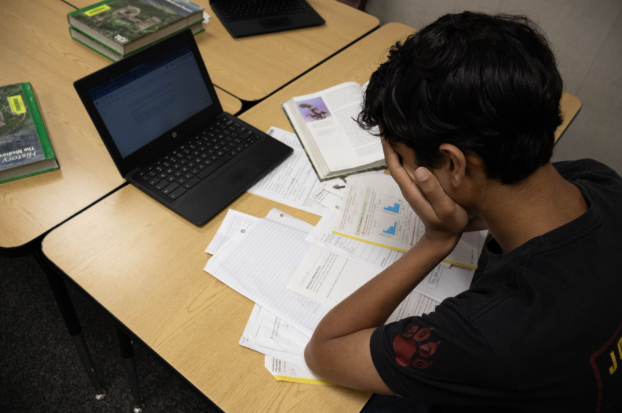
A teen stares at his phone, confronted with footage of his own behavior that has already begun circulating online.
More to Discover