Skip to Content
The spotlight crew lights up the stage during a scene in Day Creek Intermediate's production of High School Musical Jr.
The spotlight crew lights up the stage during a scene in Day Creek Intermediate’s production of High School Musical Jr.
Fabiola A.
Categories:

Running the show: how tech crew brings middle school theater to life

Behind the Curtain

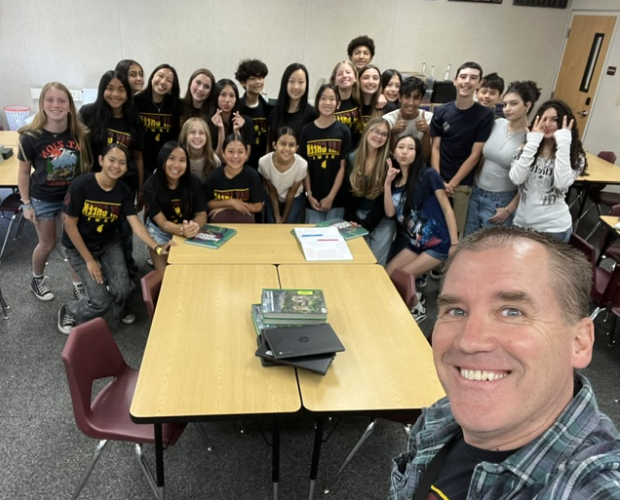
Students, clad in black, huddle around a tech board as the lights begin to dim. Annotated scripts in their laps tell them when to cue the music as they try to relax in their chairs. In the back of the MPR, another seventh grader turns on a spotlight as Troy and Gabriella take the stage. Instead of going home, these students are learning what it takes to put on a middle school performance behind the scenes.

While audiences focus on the actors under the stage lights, the student tech crew works quietly to keep every performance running smoothly. At Day Creek, the crew is made up of six students, two per category, handling lighting, sound, and spotlights. These roles are essential to any production, from campus shows to professionals on Broadway.

This year’s musical required over 100 individual light and sound cues, all timed down to the second. An error could mean a silent microphone or a darkened stage.

“It is very cool to see the tech side of theater grow because other people always see the actors on stage, but a show can’t run without their technicians. So it is really fun to see people jump into that role and accept theater from a different side,” said Mrs. Harris, sixth grade teacher and theater director.

Learning the Ropes

The tech crew consists of three groups: spotlights, sound board, and lights. Whether it is clicking on a mic to pick up a harmony or spotlighting a face, tech plays a major role in storytelling and performance. However, these middle schoolers do not arrive at rehearsal already knowing how to cue music or navigate a complicated light board. Instead, they rely on guidance from a teacher.

“It’s interesting because I did not start in tech, so I kinda had to pre-teach myself before I could teach the kids. I have had experience doing sound before, but lights are a whole ‘nother beast of its own,” said Mrs. Harris.

Members of the tech crew rehearse three days a week for nearly two months before opening night, staying after school for an hour and a half. During that time, they program cues, test microphones, adjust lighting angles, and run full technical rehearsals without an audience.

With students running through cues in their heads and studying scripts after school, being on crew becomes a major part of their lives. As the end of the year approaches, many students begin looking ahead to high school and new extracurricular opportunities.

Light operator and eighth grader Brandon V. said, “[Being on crew] taught me how to be responsible since I’d be at school for an hour and a half almost everyday instead of home; so I would have to manage my homework. I’m more interested in tech in high school because it is very fun and everyone should try it in their life because it’s cool. It’s very interactive and accomplishing. When the show is over, I just feel very successful.”

With early exposure to tech crew, students feel more prepared as they move into high school.

“If I want to do drama in high school, then if I audition for crew, they won’t have to re-teach me all the stuff. I can just go and do anything they need me to do,” said Kaelynn M., a seventh grade sound and mic operator.

Why Students Join

At the beginning of the year, posters appeared around the Day Creek campus promoting the Day Creek Drama Team, including crew opportunities. Students scanned a QR code and signed up to audition or try out for crew.

For some, the appeal was the people they would work with. “I like that I get to be with my friends, and I like that I get to watch the musical and participate in it. I wanted to do it because my friends were in the musical. And I also wanted to be in it, but not be in the ensemble or anything,” said seventh grader and spotlight operator Lylah G.

Others were drawn to the opportunity to be part of a production without stepping on stage. For students with stage fright, crew offers a way to contribute without performing in front of an audience.

“You get to be a part of the production, but you don’t actually have to sing or be on stage. You’re still part of it. I don’t like being in front of crowds,” said Kaelynn M.

For students, crew is not just an extracurricular activity to do after school, it is an opportunity to explore interests and try something new.

The Pressure Behind the Scenes

While working behind the scenes avoids the spotlight, it comes with pressure. A single missed cue can disrupt the show and confuse both performers and the audience.

“I have to make sure everything’s on time. So basically the entire show is on us. If we mess up on mics, sound, lights, or cues, the show will not be that great,” said Kaelynn.

After the first opening show, in between the next,  the sound system completely crashed, forcing the crew to quickly switch to a backup program. The audience never knew, but behind the tech table, hearts were racing. Moments like that test both preparation and composure.

Through both successes and mistakes, students gain valuable experience from working on a production.

“I hope that they learn a new skill and grit, because things don’t always go according to plan. Sometimes you have to adapt. Technology is technology, so it doesn’t always work the way we expect it to,” said Mrs. Harris. “You have to stay calm in those situations and always have a plan A through Z, because once you panic, there’s no way to fix it. Just keep the cycle going.”

Taking the lessons they learned throughout their life, crew becomes an early opportunity to learn lessons, make mistakes, and have fun.

The Final Curtain

In the end, during the final curtain call, these students have helped bring a performance to life. Alongside the cast, they use sound, lights, and precise timing to support emotional storytelling.

Tech lead Jaden H. said, “After completing a show, it feels like getting off a fast roller-coaster. It feels exhilarating that you accomplished something really great.”


More to Discover